Thursday, August 30, 2012

Types of Valves


Various types of Valves have been developed to cater to the diversified requirements of fluid control in various applications. These types of valves match the systems, fluids, and environments to accomplish their intended function.

Each type of valve has been designed to meet specific needs. Some valves are capable of throttling flow, other valve types can only stop flow, others work well in corrosive systems, and others valves handle high-pressure fluids. Each valve type has certain inherent advantages and  disadvantages. Understanding these differences and how they affect the valve’s application or operation is necessary for the successful operation of a facility.

Although all valves have the same basic components and function to control flow in some fashion, the method of controlling the flow can vary dramatically.
Each method controlling flow has characteristics that make it the best choice for a given application of function. One valve may be best fit for one application but may not be fit for other at the same time.
types of valves
                    Classification of valves
Classification of Valves

Fluid control valves are classified in many ways. Following is the classification of valves.

Multi Turn and Quarter Turn Valves

Multi turn valves need many turns of actuator to bring closure member (disc) from fully open position to fully closed position. Examples of multi turn valves are gate valves, globe valves, needle valves, and diaphragm and pinch valves.
While quarter turn valves need only quarter ,0 to 900 degree, motion of closure member (disc) to bring it from full open position to full closed position.  Examples of quarter turn valves are butterfly valves, ball vales and plug valves etc. Quarter turn vales are quick opening valves.

Self actuated Valves

Self actuated valves don’t need actuator to operate them. These valves operate based on some property of fluid line like pressure or flow. Self actuated valves don’t need operator’s interference to control the fluid. Examples of self actuated valves are check valves and pressure relief valves or safety valves.

Linear Motion and Rotary Motion Valves

In linear motion valves, disc moves in linear or straight path to open, close or throttle the flow in valve. While in Rotary motion valves, disc rotates to open, close or throttle the flow. Examples of linear motion valves are gate valves, needle valves, globe valves, diaphragm valves and pinch valves. Examples of Rotary motion valves are ball valves, butterfly valves etc.
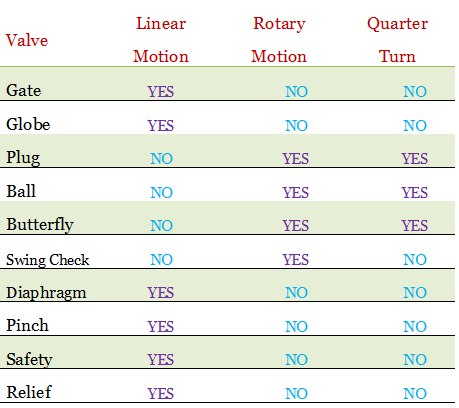
valve types
General types of valves
 General Types of valves

In general following are the types of valves.
  • Gate valve
  • Globe Valve
  • Pinch Valve
  • Needle valve
  • Diaphragm valve
  • Ball valve
  • Butterfly Valve
  • Check valve
  • Pressure relief Valve (safety or relief valve)

Valve Basics


Definition of Valve

  • In mechanical engineering, a Valve is a mechanical device that controls the flow of fluid and pressure within a system or process. 
---------------------------------------------------------------------------------------------
  • Valve is any device for closing or modifying  the passage through a pipe, outlet, inlet, or the like, in order to stop, allow, or control the flow of a  fluid media.
---------------------------------------------------------------------------------------------
  • Valve is mechanical or electromechanical device by which the flow of a gas, liquid, slurry, or loose dry material can be started stopped, diverted, and/or regulated or throttled.
 
Use of Valve or Applications of valves

Valve is found everywhere. Applications of valves have great variety and breath. Where there is flow of fluid, there would be valve to control the flow. 

Can you think of pipe having fluid (liquid or gas) running through it and no valve to stop, start or regulate the flow? 
valve
Valves are found in power plants, process plants, hydal applications, hvac application and domestic applications. Valve is used in steam lines and gas lines also for control purposes. Air control valve is also use for control purposes .Failures of valves may be catastrophic for the whole system depending upon the type of application. 

Leaky, rusty and noisy valves indicate the lack of right Maintenance Programs for valves. Sometimes valve leaks may have health hazards .Obviously no one wants to waste chemistry controlled fluid through these valves. Your leaky valve would make it impossible to isolate any equipment or system at the time of maintenance so all valves need attention before they become headache for you.
 
Function of valve

A valve controls system or process fluid flow and pressure. These aforesaid objectives of valves are achieved by performing any of the following functions:
  • Stopping and starting flow of fluid
  • Varying (throttling) the amount of flow of fluid
  • Regulating downstream system or process pressure
  • Controlling the direction of flow of fluid
  • Relieving component or piping over pressure
Flow control Valve  ------- 4 Methods By which it works

As a student of mechanical engineering, plant engineers, plant technician, maintenance technician or plant operator you might be interested in knowing how flow is controlled in these valves. In general, there are four methods of controlling flow through a valve.

  1. Move a disc, or plug into or against an orifice (for example, globe or needle type valve).
  2. Slide a flat, cylindrical, or spherical surface across an orifice (for example, gate and plug valves).
  3. Rotate a disc or ellipse about a shaft extending across the diameter of an orifice (for example, a butterfly or ball valve).
  4. Move a flexible material into the flow passage (for example, diaphragm and pinch valves).
 

Tuesday, August 28, 2012

5 Heat Transfer Loops in HVAC System


Several heat transfer loops work in an HVAC system .In these heat transfer loops heat energy is exchanged to achieve the ultimate purpose of heating and cooling of air in HVAC system

These heat transfer loops are basic organs of any HVAC system. Problem in any of these loops affects the HVAC system .In these heat transfer loops thermal or heat energy moves from left to right as it is extracted from the space and rejected into surroundings or air through five loops of heat transfer.

heat transfer loops in HVAC system
Heat transfer loops in HVAC system

1. Indoor air loop in HVAC system  

In the left loop, indoor air is driven by the supply air fan through a cooling coil, where it transfers its heat to chilled water. The cool air then cools the building space or different HVAC zones.

2. Chilled water loop in HVAC system

Driven by the chilled water pump, water returns from the cooling coil to the chiller’s evaporator to be re-cooled.

3. Refrigerant loop in HVAC system

Using a phase-change refrigerant, the chiller’s compressor pumps heat from the chilled water to the condenser water.

4. Condenser water loop in HVAC system

Cooling water absorbs heat from the chiller’s condenser, and the condenser water pump sends it to the cooling tower.

5. Cooling tower loop in HVAC system

The cooling tower’s fan drives air across an open flow of the hot condenser water, transferring the heat to the air.Thus cooling tower rejects heat to atmosphere in this way.

Friday, August 10, 2012

HVAC Water Chillers Quiz # 4

Following HVAC MCQs practice Quiz Questions are related to ,HVAC ,water chillers, absorption cooling chillers ,(single effect and double effect) and Lithium Bromide Chillers.


(See here HVAC quiz # 1   HVAC Quiz # 2    HVAC Water Chillers Quiz # 3 )


(Should you  require following hvac quiz in pdf /ms word form,write down your email address in the comments below) 


  1. Capacity of absorption chiller is controlled through.

  2. heat source
    cooling water
    chilled water flow
    all of above

  3. Which of the following statements is true for a lithium bromide?

  4. It has same boiling point as water
    Its absorption capacity decreases with temperature
    It is used as refrigerant in absorption chiller
    More than one statement is true

  5. Which of the following statements is true for low pressure generator of lithium bromide chiller?

  6. It heats the intermediate solution with vapors
    It heats the vapor-solution by intermediate solution
    It has its own steam source for heating the weak solution
    None of above

  7. Which of the following statements is true for high pressure generator of lithium bromide chiller?

  8. It heats the intermediate solution with vapors
    It heats the vapor-solution by intermediate solution
    It has its own steam source for heating the weak solution
    None of above

  9. Which of the following statements is true for evaporator of lithium bromide chiller?

  10. refrigerant gets vaporized by lithium bromide
    refrigerant gets vaporized by taking heat from chilled water
    Refrigerant is condensed by cooling water
    None of above

  11. Which of the following statements is true for condenser of lithium bromide chiller?

  12. refrigerant gets condensed by lithium bromide
    refrigerant gets vaporized by taking heat from chilled water
    Refrigerant is condensed by cooling water
    None of above

  13. Which of the following statements is true for absorber of lithium bromide chiller?

  14. vapor absorb lithium bromide in it
    vapors are absorbed by lithium bromide in it.
    absorbent is condensed by cooling water
    None of above

  15. Which of the following statements is true for LT heat exchanger of lithium bromide chiller?

  16. It heats the intermediate solution with weak solution
    It heats the weak solution with intermediate solution
    It heats the weak solution with solution coming from low pressure generator
    None of above

  17. Which of the following statements is true for HT heat exchanger of lithium bromide chiller?

  18. It heats the intermediate solution with weak solution
    It heats the weak solution with strong solution
    It heats the weak solution with solution coming from low pressure generator
    It heats the weak solution with solution coming from HP generator

  19. Which of the following statements is true for refrigerant pump of lithium bromide chiller?

  20. It transports weak solution from evaporator to absorber
    It transports the strong solution from generator to absorber
    It transfers the weak solution from absorber to generator
    It sprays again the refrigerant within evaporator from bottom

Related Posts Plugin for WordPress, Blogger...